
In today’s digital world, it’s scary how quickly technology advances and evolves. In fact, it can feel almost impossible to keep up with it, especially for anyone who’s seen a few more summers than others.
For most of us, there’s no need to keep up to date with every little new thing. That’s good news – it means we don’t get overwhelmed. However, as event organisers, our job at Mercian Events is to provide a seamless, efficient and cost-effective experience.
That involves a little relevant technology.
In this blog post, we’ll talk about recent technological advances in the events industry, and how you might use them when planning your event.
Artificial Intelligence (AI)
It’s everywhere. With the release of ChatGPT earlier in the year, artificial intelligence models have become more and more prominent.
In reality, AI has been implemented in various systems for some years now. They’re usually more basic models than these new language-based units, but they’re still there.
Regarding event planning, the main benefit of AI – in short – is organisational efficiency. There’s no need to draft long emails or documents or spend all your time copying and pasting when AI is on-hand.
Online/Hybrid Events
When the COVID lockdowns hit in early 2020, we naturally saw almost all events turn to video conferencing applications like Zoom, Microsoft Teams, Google Meet and Skype. While these posed initial challenges, we’ve become used to hosting these online-only events.
Virtual events bring several benefits, such as a much lower cost, a streamlined lineup and a far lower carbon footprint. However, downsides include much less attendee-to-attendee interaction and communication.
After the lockdowns lifted, people gradually returned to work, spending some time at home and some at the office. Thus, most of us will be familiar with a ‘hybrid’ work environment.
In some cases, it might be a good idea to mix your online video conference with an in-person event. This brings its own obstacles, but an effective plan is more than enough to overcome them and make it a success.
Livestreaming
Livestreaming is far from a new concept – it was used long before COVID. In short, it’s a method of one-way communication where the speaker can be seen and heard by the audience but not vice versa. As a result, it’s naturally better for events where you aren’t expecting much immediate interaction.
It can be set up at a very low cost using existing providers, and most video conferencing apps now have livestreaming settings, preventing attendees from unmuting or turning on their cameras.
You might also consider setting up livestreaming apps or dedicated websites for viewing.
Drone Footage
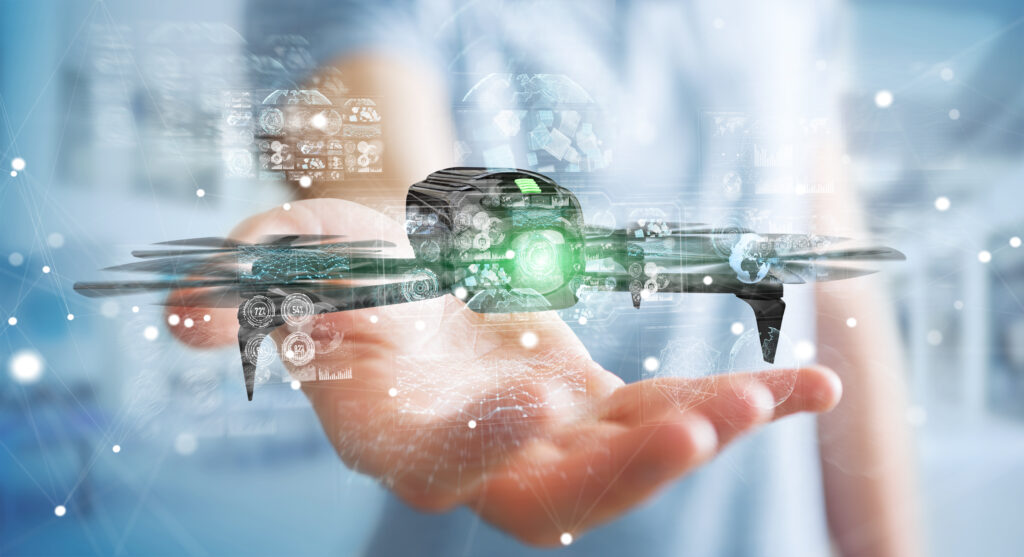
Drones are remote-controlled flying machines. They tend to be very small, nimble and easy to control (for someone trained and experienced with them).
The main benefit of using drones at your event will be video footage. Tiny, high-resolution cameras can be attached to these models. As they’re flown over the top of your event, you’ll end up with impressive shots to showcase your event after it finishes.
Don’t let that limit your creativity, though. Drones could be used in all sorts of ways, such as for pulling lightweight banners. We’ve even heard of drinks being served through drones.
The sky’s the limit (quite literally).
Virtual Reality (VR) & Augmented Reality (AR)
VR allows attendees to don a headset and immediately immerse themselves in a 3D world projected into their eyes. VR technology has been used in commercial development (especially the engineering sector) for years but has become more widely available through video games console applications like Oculus, PlayStation and Xbox.
AR involves facts, figures and other information being projected onto an otherwise normal view of the world. If you’ve seen Iron Man or any of the Avengers films, you’ll know what we’re talking about.
For example, certain newer cars use AR navigation. Instead of a traditional map-like sat-nav, a camera on the front of the vehicle displays 3D arrows indicating the direction you should take, and road signs pop up on the central display.
Your event may be able to use technology like this, especially if you want to show off a product, project or workspace. It’s a more significant investment than others on this list, but it may well be worth it.
Touchscreen technology
Touchscreen technology provides an engaging, hands-on experience that can greatly enhance interaction at events. This can be implemented in various ways. For instance, information kiosks with touchscreen interfaces can allow attendees to easily navigate event schedules, venue maps and exhibitor information. Interactive digital signage can be used to display real-time social media feeds, photos or quizzes. Moreover, touchscreen technology can be used for electronic registration systems, making the check-in process quicker and more efficient for delegates.
Gamification
Gamification involves applying game-design elements and principles in non-game contexts, like events, to enhance participant engagement and enjoyment. This can take many forms, such as leaderboards, point systems or interactive challenges related to the event. For instance, delegates could earn points by attending certain sessions, networking with other participants, or completing surveys. These points could then be redeemed for rewards, creating an incentive for participation. Gamification not only makes the event more fun, it also encourages networking, learning and engagement with the event content.
Proximity beacons
Proximity beacons are small wireless devices that transmit signals using Bluetooth technology. They can be used to provide location-based services at events. For example, when a delegate with a beacon-enabled app on their smartphone comes near a beacon, they might receive a push notification with information about an ongoing session, an exhibitor nearby, or a networking opportunity. This not only provides a personalised experience but also helps guide delegates through the event. Beacons can also be used to track attendee movement and gather data on popular areas or sessions, which can provide valuable insights for future event planning.
How Mercian Events can help you make the most of technology at your next event
Mercian Events is a Worcester-based events management company. We’ve made it our mission to provide not just logistics and planning but a complete, comprehensive experience. It’s our mission to help you inspire your attendees, making them feel your excitement for your field.
With decades in the field, you can trust us to know what’s best for your company. We’ll work with you to understand your vision and brand identity, transferring that information into an event that truly represents your business.